

KNOWLEDGE on Tap: The Development of the Gut Microbiota (AL47377)


The Development of the Gut Microbiota

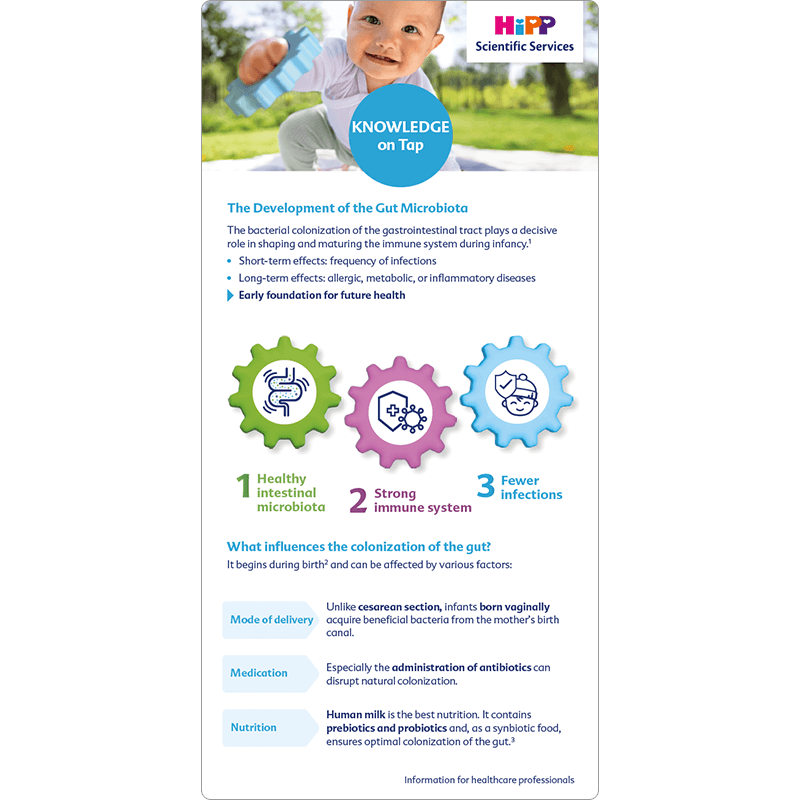
The bacterial colonization of the gastrointestinal tract plays a decisive role in shaping and maturing the immune system during infancy. In addition to short-term effects such as the frequency of infections, the development of the gut microbiota also has long-term impacts on the occurrence of conditions such as allergic, metabolic, or inflammatory diseases.¹ A healthy gut microbiota sets the course for life.
When does colonization of the gut begin?
Recent research suggests that the first microbial colonization of the gut occurs during birth.² A cesarean section (compared to vaginal delivery) and the administration of antibiotics can lead to altered colonization. Another decisive factor afterward is nutrition.¹
Human milk – a synbiotic food
Human milk is the optimal nutrition for infants. In addition to many valuable components, probiotic bacteria and prebiotic oligosaccharides contribute to the development of a healthy, physiological gut microbiota.³ The combination of both is referred to as synbiotics.
Probiotics and prebiotics in infant formula
To provide non-breastfed infants with at least a similar benefit, commercial infant formulas are also enriched with prebiotics and/or probiotics. Since comparative studies are lacking, it is crucial which evidence manufacturers can provide in clinical trials regarding the safety and benefits of their products.
Expert opinions
The international expert panel ESPGHAN has once again commented on the topic of pre- and probiotics in infant formula. In various reviews, they concluded that the currently available pro-, pre-, and synbiotic infant formulas are safe and pose no negative effects. Although the number of efficacy studies has increased in recent years, further studies demonstrating clear benefits are still required.⁴
Efficacy studies with infant and follow-on formulas
For the combination of probiotic L. fermentum CECT 5716 and prebiotic galacto-oligosaccharides (GOS) used in HiPP COMBIOTIC®, several studies are currently available, known as the GOLF studies. These demonstrated positive effects on gut microbiota and the immune system, as well as a lower number of respiratory and gastrointestinal infections. In GOLF I, the intervention formula was a follow-on formula. An increase in bifidobacteria (+70%) and lactobacilli (+78%) was observed. The number of upper respiratory tract infections was significantly reduced by 26%, and gastrointestinal infections by 46%.⁵ GOLF II examined the use of an infant formula. Here, an even greater effect on gastrointestinal infections was observed, with a significant reduction of 71%.⁶ After 3 years, follow-up of this study showed no differences in anthropometric data, infection risk, or microbiota data. Long-term safety was thus confirmed.⁷ The current study – GOLF III – investigated both infant and follow-on formulas. Thanks to the pre- and probiotics GOS and L. fermentum, the formula promoted a gut microbiota more similar to that of breastfed infants.⁸ Additionally, the number of lower respiratory tract infections was significantly reduced by 23%. The incidence was comparable to the reference group of breastfed infants.⁹
Conclusion
A healthy gut microbiota ensures good immune system and health development from the very beginning. Synbiotic infant formulas are safe and incorporate insights from human milk research. They can positively influence gut microbiota and the immune system, thereby reducing the number of infections.
Suitable advice card
References:
1 Maasjosthusmann P Monatsschr Kinderheilkd 2025; 173: 646–653.
2 Kennedy KM et al. Nature 2023; 613: 639–649.
3 Haiden N Kinder- und Jugendarzt 2025; 56: 481–488.
4 Dinleyci E et al. JPGN 2025; 1–16.
5 Maldonado J et al. JPGN 2012; 54: 55–61.
6 Gil-Campos M et al. Pharm Res 2012; 65(2): 231–8.
7 Maldonado J et al. Pharmacol Res 2015; 95-96: 12–19a.
8 Lagkouvardos I et al. Am J Clin Nutr 2023; 117 (2): 326–339.
9 Piloquet H et al. Am J Clin Nutr 2024; 119(5):1259–1269.