

ESPGHAN Infant Feeding Campaign 2026
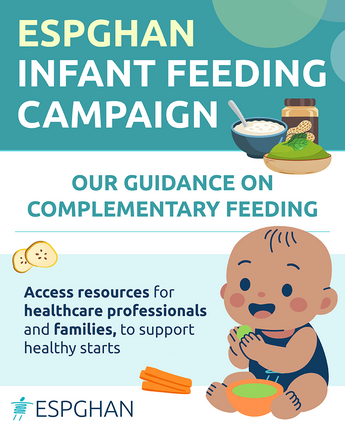
The ESPGHAN (European Society for Paediatric Gastroenterology Hepatology and Nutrition) launched a new Infant Feeding Campaign.
Infant feeding practices vary widely between countries and healthcare professionals and parents are still confronted with contradictory advice, cultural barriers, gaps in guidance, and inconsistent support during the complementary feeding (CF) period.
The campaign was created to improve infant and young child feeding practices across Europe by providing clear, evidence based, and consistent guidance for healthcare professionals and caregivers.
The goal is to promote healthy, safe, responsive, and context-appropriate complementary feeding practices that reflect the diversity of families’ environments, cultures, and resources - while ensuring infants have the best possible start to life.
New library of resources
- To support complementary feeding across Europe (for healthcare professionals, parents and carers)
- Free to download, use and share
- Endorsed by General Paediatric Societies
The library comprises Healthcare Professional Resources and Family Resources.
Main messages and key points
- Breastfeeding as the foundation
- Exclusive breastfeeding should be promoted for at least 17 weeks, with exclusive or predominant breastfeeding for about 6 months.
- Breastfeeding should continue alongside complementary feeding once solids are introduced.
- Appropriate timing of complementary feeding
- Complementary foods should be introduced after 17 completed weeks, but no later than 26 weeks.
- Timing should reflect infant developmental readiness.
- Nutritional quality and diversity of foods
- Complementary foods should provide iron rich options, including meat, eggs or plant-based options such as pulses or fortified foods and formula.
- Infants should be exposed to a variety of flavors and textures, including bitter vegetables.
- No added salt or sugar should be used, and sugary drinks should be avoided.
- Offer water, breastmilk, or formula as the main drinks. Animal milks should not be used as the main drink before 12 months.
- Introduction of allergenic foods
- Potentially allergenic foods (e.g. egg, peanut) do not need to be delayed and can be introduced in safe form once complementary feeding begins.
- For infants at high risk of peanut allergy, early introduction between 17 weeks and 11 months.
- Responsive feeding practices
- Caregivers should practice responsive feeding, recognizing hunger and satiety cues.
- Breastfeeding on demand alongside complementary feeding.
- Feeding should not be used as a reward or comfort method.
- Structured meal routines and modelling healthy eating behaviours support long-term dietary habits
- Special diets require professional guidance
- Vegetarian and especially vegan diets in infancy require careful medical or dietetic supervision.
- Inadequate supplementation can cause serious health consequences.
Find out more:
Infant Feeding Campaign | ESPGHAN