KNOWLEDGE on Tap: Skincare recommendations for healthy baby skin (AL46867)
Evidence-based scientific recommendations for a general skincare regime for healthy infant skin during the first year of life:4,6


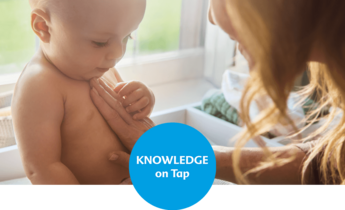
In infants, the skin surface area in relation to body weight is twice as large and five times thinner than that of adult skin. As a result, babies can lose fluids more quickly and are more prone to cooling down. Temperature and moisture regulation are limited because the sebaceous and sweat glands are not yet fully functional and the level of natural moisturizing factors (NMFs) is lower than in adult skin. Because the infant skin is more permeable and the protective acid mantle is not yet fully developed, it reacts much more sensitively to external influences than adult skin. Clear recommendations help to facilitate baby care. There are numerous recommendations regarding babys skincare. Several years ago, a European expert panel developed evidence-based guidelines for general baby care from birth until the end of the first year of life. In recent years, these recommendations have been expanded and confirmed by experts. They apply to the care of healthy baby skin; in cases of skin conditions, a different approach may be required.
In principle, bathing is safe for newborns and infants and may be preferred over washing with a washcloth, as it is considered gentler. In addition, bathed infants are generally more relaxed, cool down less, and show lower transepidermal water loss as well as a tendency toward higher skin hydration.
Infant skin requires particularly gentle care, that is limited to essential ingredients and free from unnecessary additives. This is important to preserve the skin’s natural balance. Potential allergens include, among others, essential oils as well as certain preservatives such as parabens. To minimize stress on the skin, products should also avoid PEG emulsifiers, alcohol (ethanol), and soaps, as these can damage the skin’s protective acid mantle.
Skincare products for sensitive and dry skin ideally contain natural yet nourishing ingredients, such as almond oil or shea butter, as well as moisturizing components like glycerin. It is also advisable to choose products bearing reliable quality seals, such as that of the German Allergy and Asthma Association (DAAB), as these meet strict requirements regarding the selection and tolerability of ingredients.
Atopic dermatitis, with a prevalence of 10–15%, is the most common chronic skin disease in childhood.5 Its causes are described as multifactorial and include, among others, a genetic predisposition, an impaired skin barrier, and alterations of the immune system.
As a weakened skin barrier is often promoted by very dry skin and external influences, regular skincare using products that provide both moisture and lipids is recommended in order to support the maturation of the skin barrier. According to a recently conducted study, infants without a genetic predisposition to atopic dermatitis may particularly benefit from consistent skincare.6
In general, when selecting skincare products, not only the ingredients but also the individual skin condition and the season should be taken into account.
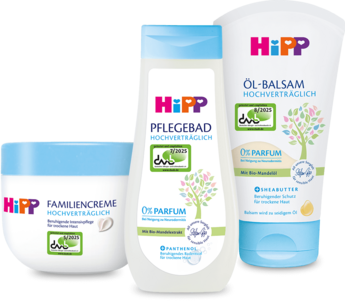
for highly sensitive skin, dermatologically confirmed and tested and recommended by the German Allergy and Asthma Association (DAAB).
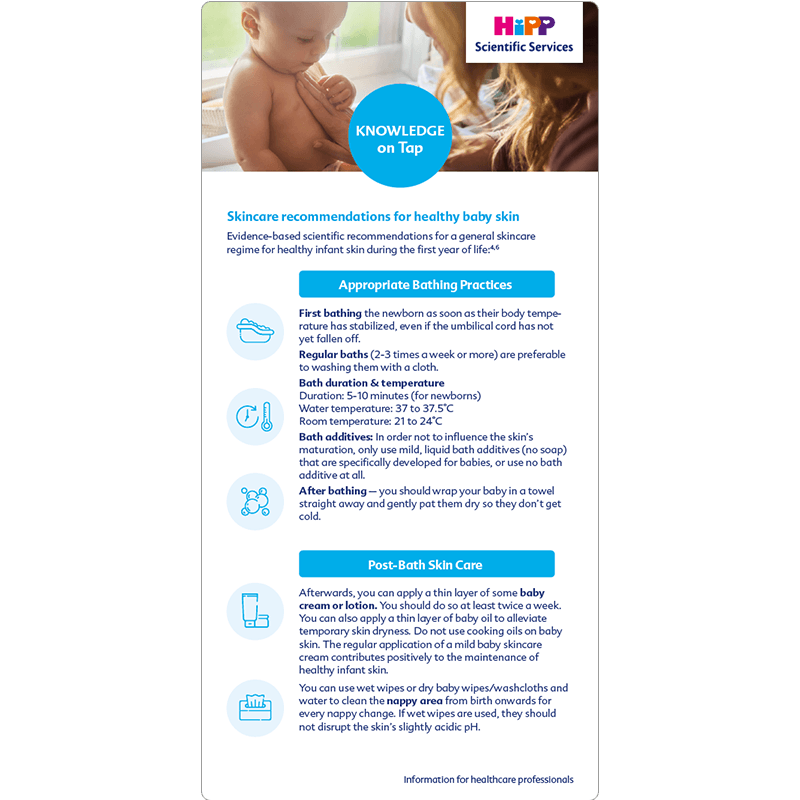
Evidence-based scientific recommendations for a general skincare regime for healthy infant skin during the first year of life:4,6
References:
1 Blume-Peytavi, U., Wilborn, D., Amin, R., & Kottner, J. (2023). Skin care in neonates and infants: A scoping review. Skin Pharmacology and Physiology, 36(2), 51–66.
2 AWMF (2023). S3 guideline: Atopic dermatitis. AWMF Register No. 013/027. Accessed December 1, 2025. https://www.awmf.org/leitlinien/
3 AWMF (2022). Care of newborns in maternity hospitals. AWMF Register No. 024/005. Guideline class: S2k. Accessed
December 1, 2025. www.awmf.org/leitlinien/
4 Blume-Peytavi, U., et al. (2016). ecommendations from a European roundtable meeting on best practice in healthy infant skin care. Pediatric Dermatology, 33(3), 311–321..
5 Abeck, D. (2016). New recommendations for infant care. The Midwife (Die Hebamme), 29, 303–306.
6 Simpson, E. L., Michaels, L. C., et al. (2025). Emollients to prevent pediatric eczema: A pragmatic and decentralized randomized clinical trial. JAMA Dermatology, 161(9), 957–965.